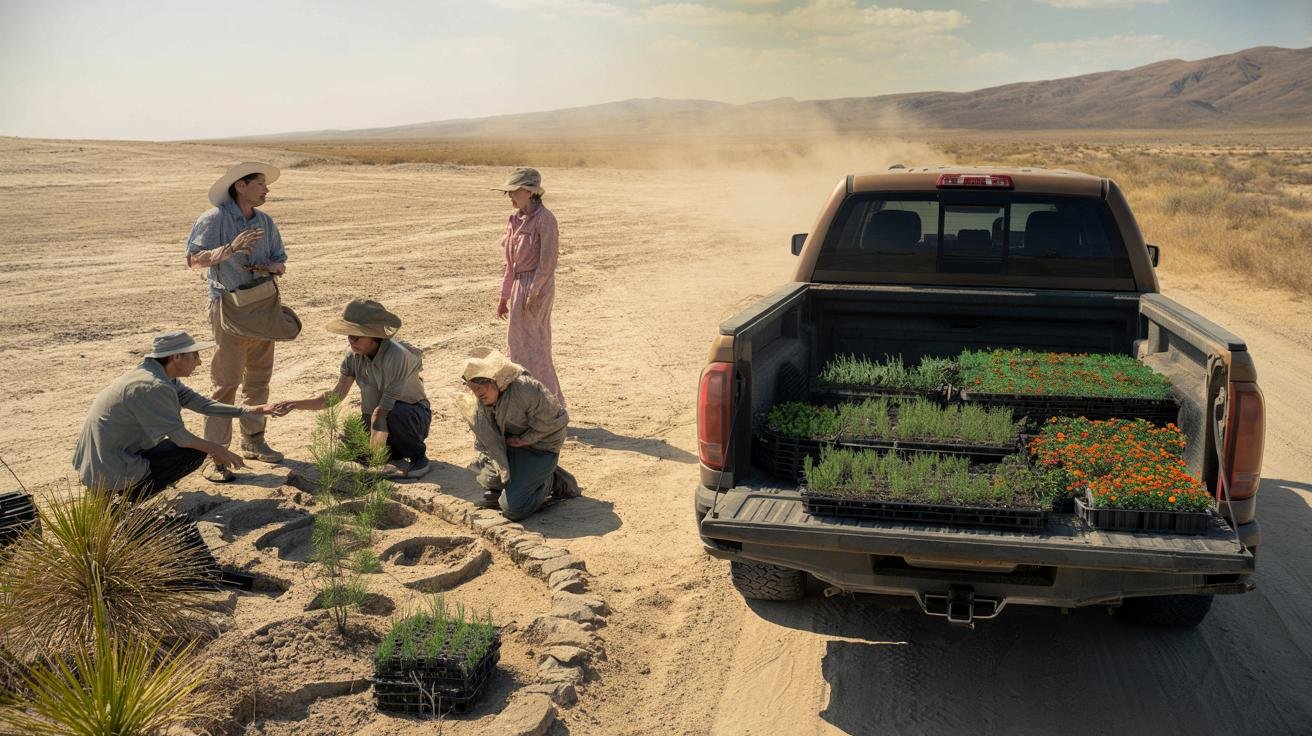
It starts with a faint dust cloud on the horizon of northern Mexico’s Chihuahuan Desert. A pickup rattles down a dirt track, its bed piled high with black plastic trays trembling with green. Not tourists. Not construction. Baby mesquites, wolfberries, desert marigolds. Tiny flashes of life heading into a landscape that, for years, has been quietly falling apart.
The air smells of hot metal and dry sage as volunteers jump off the truck, boots sinking into powdery, exhausted soil. One woman says softly, “Hard to believe this was grassland when my grandfather was a kid.” She presses a seedling into the ground like she’s tucking in a child.
All around her, millions of other seedlings are being planted across deserts on four continents.
The big bet: can five million native plants really reboot a dying ecosystem?
Latest Posts
- With Just 1 Bottle of Water How I Was Shocked by What Happened When Growing Vegetables
- Maximize Your Home Garden with the Hanging Pea Sprout Growing Model – Space-Saving, High-Yield, and Easy-to-Manage Vertical Gardening Solution
- Just Water – The Secret to Growing Plump, White Peanut Sprouts Right at Home: A Step-by-Step Guide for Beginners
- Growing Zucchini at Home in a Container: How to Cultivate Large, Long Fruits with a 1-to-72 Day Step-by-Step Diary for Maximum Yield
- Grow Long Beans on the Terrace in Used Recycling Baskets: The Ultimate Guide to Easy, Space-Saving, and High-Yield Terrace Gardening
- How to Grow Tons of Long Beans Easily Without a Garden – A Complete Guide to Growing Healthy Yardlong Beans Without Fertilizers or Pesticides
- Easy Long Bean Growing Trick – No Garden, No Fertilizer, No Pesticide
- Grow Bitter Melon in Bottles — Harvest So Big You Can’t Eat It All! The Ultimate Guide to Bottle Gardening for Maximum Yields
- Growing Garlic Made Easy: No Soil, Fast Results – The Ultimate Guide to Growing Fresh Garlic Indoors Without Traditional Soil
- Wall-Mounted Hydroponic Watermelon System: Grow Large, Juicy, and Delicious Watermelons at Home with Minimal Space and Maximum Yield
When deserts are not just “empty” — they’re hanging by a thread
Stand still in the midday heat of the Sahel and you feel it: the land is tired.
The soil is loose, the wind gets a little too bold, the horizon looks dusty instead of sharp.
For decades, we’ve spoken about deserts as if they were blank spaces on the map, already “lost” to heat and sand. Yet many of these places were once patchy grasslands, dotted with shrubs, home to nomadic herders and surprisingly rich wildlife. What looks like “natural desert” is often the end result of overgrazing, deforestation and bad water management.
That’s why a quiet revolution is underway. From Morocco to Mongolia, from Arizona to inland Australia, restoration teams are betting big on native plants to slow land degradation.
The numbers are dizzying: more than five million seedlings and direct-seeded natives, dug in by hand or dropped by drones, across some of the world’s harshest soils.
Promoted Content
In Niger, on the southern edge of the Sahara, farmers have been guiding the return of native trees and shrubs for years. They don’t always call it “ecological restoration”. They just call it survival.
On a small farm near Zinder, a father of five points to stubby stems of native acacia and faidherbia trees poking out of his millet field. Twenty years ago, he says, there were almost none. Today, satellite images show millions of these farmer-managed trees reclaiming dry fields across the country. Yields are up, wind erosion is down, birds have returned.
A similar story plays out in Australia, where more than 1.2 million saltbush and bluebush shrubs have been reintroduced to overgrazed rangelands in New South Wales and South Australia. Sheep still graze, but now they browse among natives that hold the soil and shade the ground.
These projects don’t make headlines like giant dams or solar farms. Yet, quietly, they’re reshaping entire drylands.
The science behind this green wave is surprisingly simple. Native desert plants know how to suffer well. Their roots go deep or wide, building organic matter, trapping moisture and anchoring fragile soil. Their canopies nudge down ground temperatures by a few degrees, which is often the line between life and death for seeds and microbes.
As vegetation returns, it breaks the vicious cycle: bare soil reflects more heat, heat dries the soil, dry soil loses structure, wind and water wash it away. Even small clusters of shrubs can turn that spiral backwards, creating so-called “fertility islands” where seeds, insects and nutrients gather.
Over time, these patched oases begin to connect, and that’s when the magic starts: more insects, more birds, the shy return of foxes, hares, even antelopes in some Sahel areas.
It looks slow from the outside. On the ground, you feel the shift in just a few rainy seasons.
How you replant a desert without breaking it again
The first rule shared by nearly every successful arid restoration project is disarmingly humble: start small and mimic what the land already wants to do.
Crews in Arizona’s Sonoran Desert, for example, don’t just drop five million plants into the sand and hope for a miracle. They walk the land after rare rainfalls, reading the faint dark streaks where water has lingered, spotting natural microbasins, watching where leaves accumulate. Then they copy those patterns with simple tools. Rock “berms” to break the flow of runoff. Shallow crescent-shaped pits to catch every drop of stormwater. Little brush fences to slow the wind.
Into those tiny, carefully prepared niches go the natives: ironwood, saguaro nurse plants, brittlebush, fairy duster. Survival rates jump because the seedlings are not fighting the full desert alone.
They’re slipping back into a water pattern that already exists.
The biggest mistake, many project leaders admit, is trying to plant like you would in a wet, temperate park. Big machinery, neat rows, fast timelines, donor pressure for numbers on a slide. Deserts punish that mindset.
Seedlings planted in long, exposed grids often die within a season. Imported species sometimes outcompete local ones, then crash at the first severe drought. And when you irrigate too much at the start, roots stay shallow; once the tap turns off, they fail. We’ve all been there, that moment when good intentions quietly backfire because the context was louder than the plan.
Restoration ecologists now talk about “social drought” too. Communities excluded from planning may later cut or uproot new vegetation for firewood or grazing because they never felt the project was theirs.
Let’s be honest: nobody really guards a tree they were never asked about.
“People think the hard part is keeping seedlings alive in 45°C heat,” says Tunisian ecologist Aïcha Ben Ghali. “The real challenge is growing trust, not just plants.”
- Choose hyper-local natives
Seeds from nearby wild stands or old field trees tend to handle heatwaves and pests better than nursery imports grown in mild climates. - Plant in rough, irregular clusters
Scattered “islands” of shrubs and grasses copy natural patterns, shield each other from wind, and help wildlife move between safe spots. - Invest in water harvest, not just water supply
Small earthworks, stone lines and catchment pits often do more good than extra hoses and tanks during the first hard years. - Share control with local users
Grazers, women’s firewood groups and village councils usually know where land pressures really bite. **Bringing them in early shifts projects from fragile to resilient.** - *Expect failure patches*
Even in the best-designed projects, some zones will dry, get eaten or trampled. Treat those as free feedback, not as shame.
The hidden cost: water, carbon, and who really pays
Behind every hopeful picture of a seedling in the sand sits a more awkward question: what’s the real environmental tab for all this greening?
Large-scale projects sometimes rely on miles of plastic irrigation lines, diesel pumps, imported compost and energy-hungry nurseries. Drone-seeding campaigns use batteries and rare metals. Fenced “no-go” zones can push pastoralists and wildlife into even more fragile areas next door. Critics ask whether we’re just moving the pressure around while posting feel-good photos on social media.
Some carbon-offset schemes add another layer of discomfort. Trees and shrubs are planted in drylands to “compensate” for emissions somewhere else, while locals bear the risk of failure if rains falter. The plants become numbers in spreadsheets long before they become shade for anybody.
That dissonance is starting to sting.
On the ground, many practitioners are trying to change the script. In Jordan’s Badia region, new pilot sites are cutting plastic by switching to clay pot irrigation and biodegradable mulch made from local crop residues. Nurseries are powered with rooftop solar, water is captured from rare flash floods instead of pumped from deep fossil aquifers.
In parts of the Sahel, NGOs have quietly shifted away from mass imported seedlings to farmer-managed natural regeneration: protecting and pruning native shoots that sprout from old root systems. No nursery. No plastic bags. Almost no external water. Just labor, know-how and patience. Survival rates can be higher than for planted trees, and costs drop so dramatically that critics suddenly have less to poke at.
Yet the tension remains. Who decides which land gets “restored”, and for whom? A rehabilitated pasture that feeds goats might store less carbon than a fenced thicket, but it sustains families.
Those trade-offs don’t fit neatly into glossy progress reports.
The deeper you look into this wave of desert replanting, the more it starts to resemble a social experiment as much as an environmental one. Mass reintroduction of natives gives us a way to test how we value slow processes in a world addicted to speed.
It also raises uncomfortable questions for anyone watching from far away. Are we satisfied with funding tree counts, or do we care whether those plants survive ten, twenty years? Are we willing to accept messy, uneven landscapes instead of smooth, drone-friendly grids, just because they work better for beetles and shepherds?
In the end, deserts don’t respond to press releases or key performance indicators. They respond to rain, to roots, to shade, to hoofprints, to the quiet decisions made by people who walk them every day. The next five million plants might not answer all our doubts.
They do, though, force us to decide what “healing the land” really means — and who gets to define it.
| Key point | Detail | Value for the reader |
|---|---|---|
| Native plants reshape drylands | Deep roots, shade and “fertility islands” slow erosion and kickstart food webs | Understand why some replanting efforts work while others fizzle out |
| Method matters more than numbers | Small, water-smart planting patterns often beat massive, grid-style projects | See that design and local knowledge can outweigh raw planting targets |
| Hidden costs are real | Irrigation, plastics, carbon accounting and land conflicts shape outcomes | Helps you read big “green” announcements with a more critical, informed eye |